How the EU AI Act Is Changing Digital Content Operations
Understanding what falls within scope, what needs to change, and how content teams can prepare for AI transparency requirements.
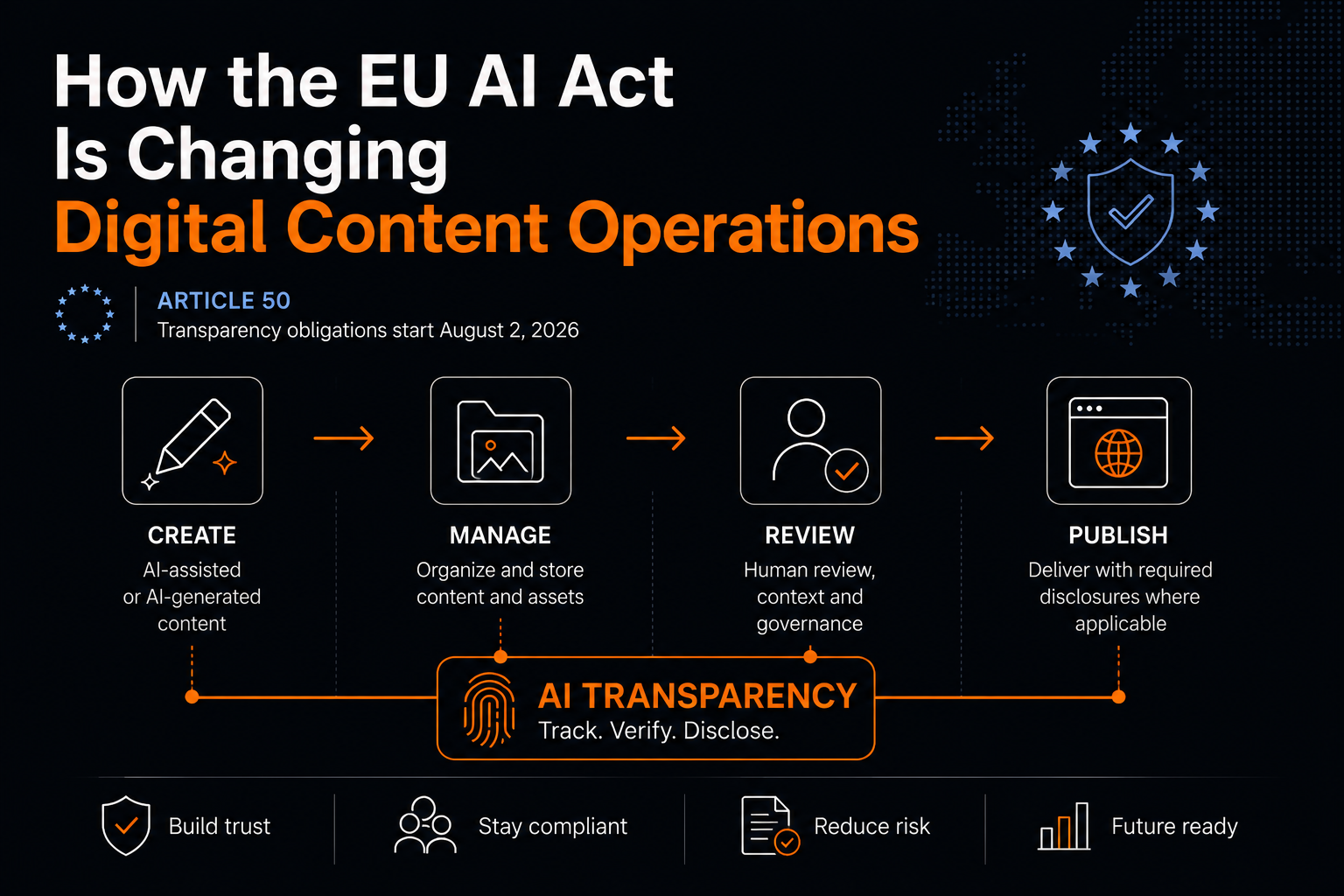
Starting August 2, 2026, transparency obligations under Article 50 of the EU AI Act become applicable for certain AI-generated and AI-manipulated content.[1] For most organizations, the impact is not limited to disclosure labels or legal reviews. It affects how content is created, managed, approved, published, and maintained across the digital content lifecycle.
Marketing teams, content authors, content operations teams, and digital experience leaders have spent the last several years integrating AI into everyday workflows. AI-assisted writing, image generation, synthetic media, chat interfaces, and personalized content experiences are now common across websites, campaigns, and customer-facing applications.
The challenge moving forward is not determining whether AI can be used. The challenge is understanding where AI was used, preserving that information throughout the content lifecycle, and communicating it when transparency obligations apply.
What Content Falls Within Scope
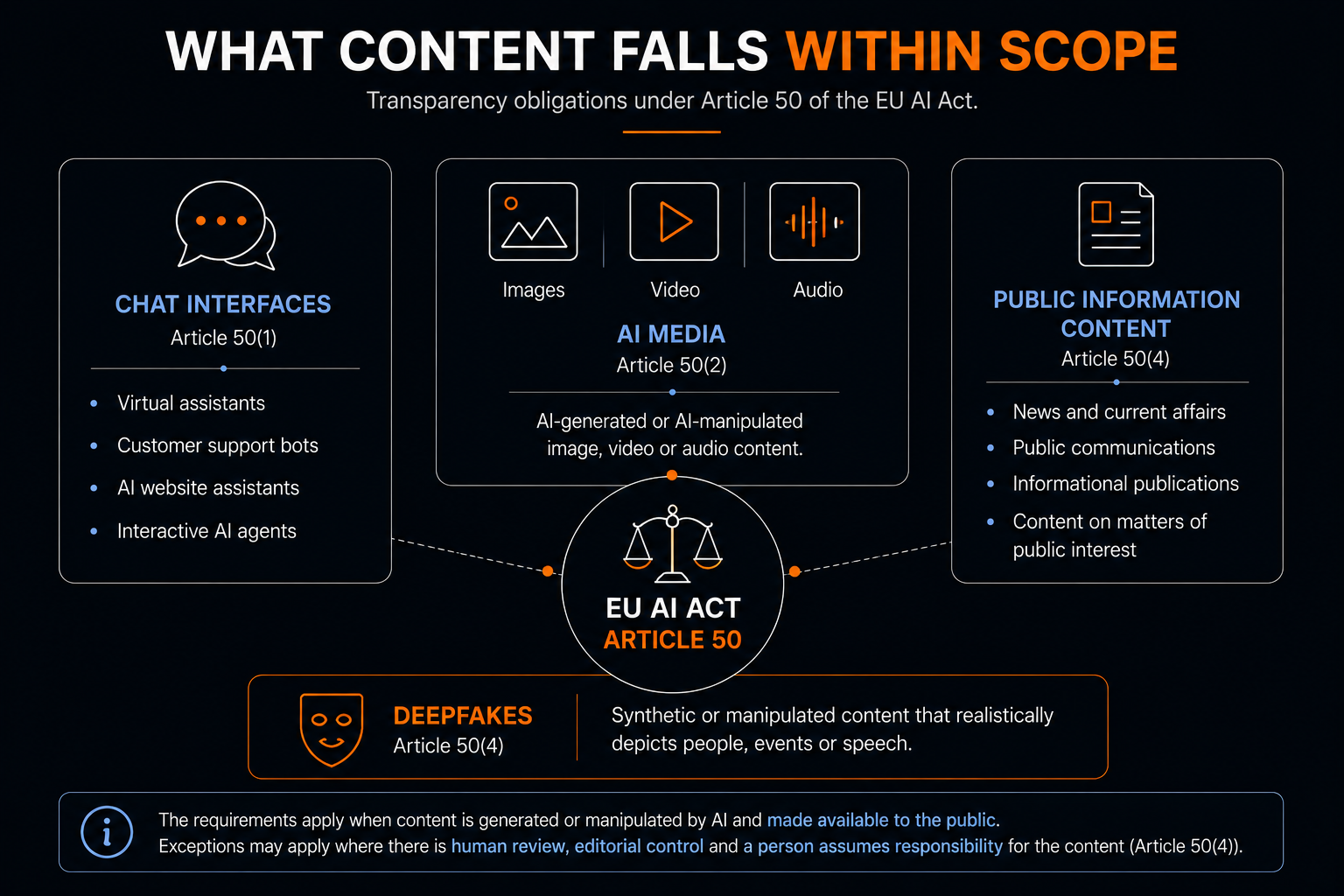
The transparency requirements do not apply to every use of AI. Instead, Article 50 focuses on specific situations where people should understand that AI played a meaningful role in creating or manipulating the content they are consuming.[1]
For digital experience platforms, CMS implementations, DAM systems, and marketing operations, the content types most likely to fall within scope include:
Content Type | Common Examples | Reference |
AI-generated images | Hero banners, campaign assets, social media creative | Article 50(2) |
AI-generated video | Product videos, promotional content, social content | Article 50(2) |
AI-generated audio | Voiceovers, synthetic narration, virtual presenters | Article 50(2) |
Deepfakes | Synthetic representations of people, speech, or events | Article 50(4) |
AI-powered chat experiences | Website assistants, support bots, virtual agents | Article 50(1) |
AI-generated public information content (text) | News, public communications, informational publications | Article 50(4) |
A Note About AI-Generated Text
One of the most common misconceptions surrounding the AI Act is that every AI-written article requires disclosure. That is not what Article 50 says. The transparency requirements for text focus on content generated or manipulated by AI and published for the purpose of informing the public on matters of public interest.[1] The regulation also recognizes situations where content has undergone human review or editorial control and a person assumes responsibility for the published output.
For most marketing organizations, the practical concern is rarely whether AI helped draft a campaign page or product description. The more relevant question is whether the organization publishes informational content where readers could reasonably expect transparency regarding the role AI played in creating that content.
What Needs To Change
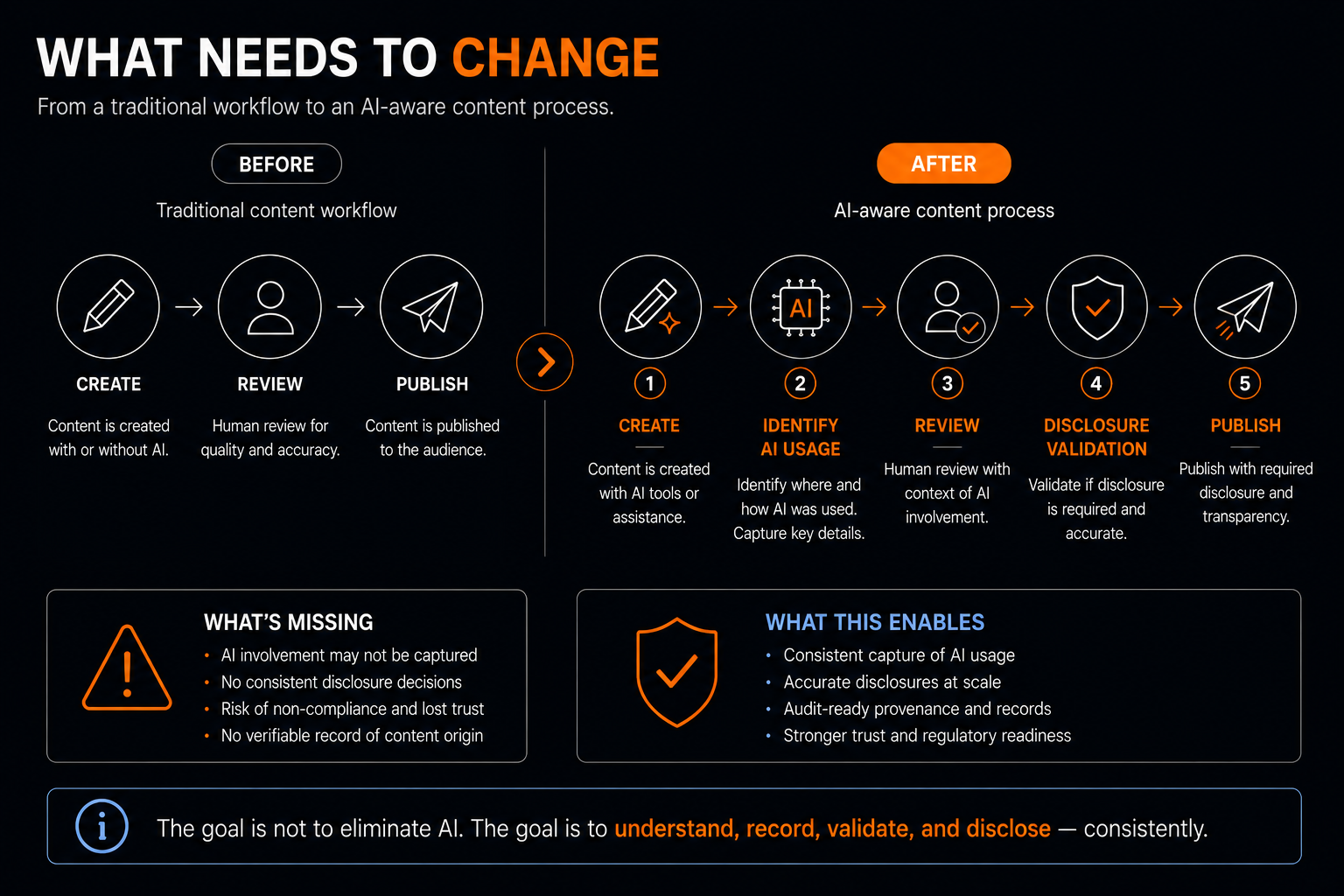
Most organizations already have content governance processes. Accessibility reviews, legal approvals, privacy controls, brand governance, and editorial workflows are standard components of modern content operations.
AI transparency introduces another governance layer that needs to be incorporated into those existing processes.
Content Creation
Content teams need a consistent way to identify when AI has been used, this includes:
AI-generated images
AI-assisted articles
AI-generated video
AI-generated audio
AI-generated content variants used in personalization experiences
Without this information at the point of creation, transparency decisions become difficult later in the publishing process.
Digital Asset Management
Images, video, and audio assets increasingly require metadata that captures AI involvement, organizations should be able to determine:
whether AI was involved
which tools were used
whether human review occurred
whether provenance information exists
This information becomes part of the asset's operational history and should remain available as content moves between systems.
CMS Content Models
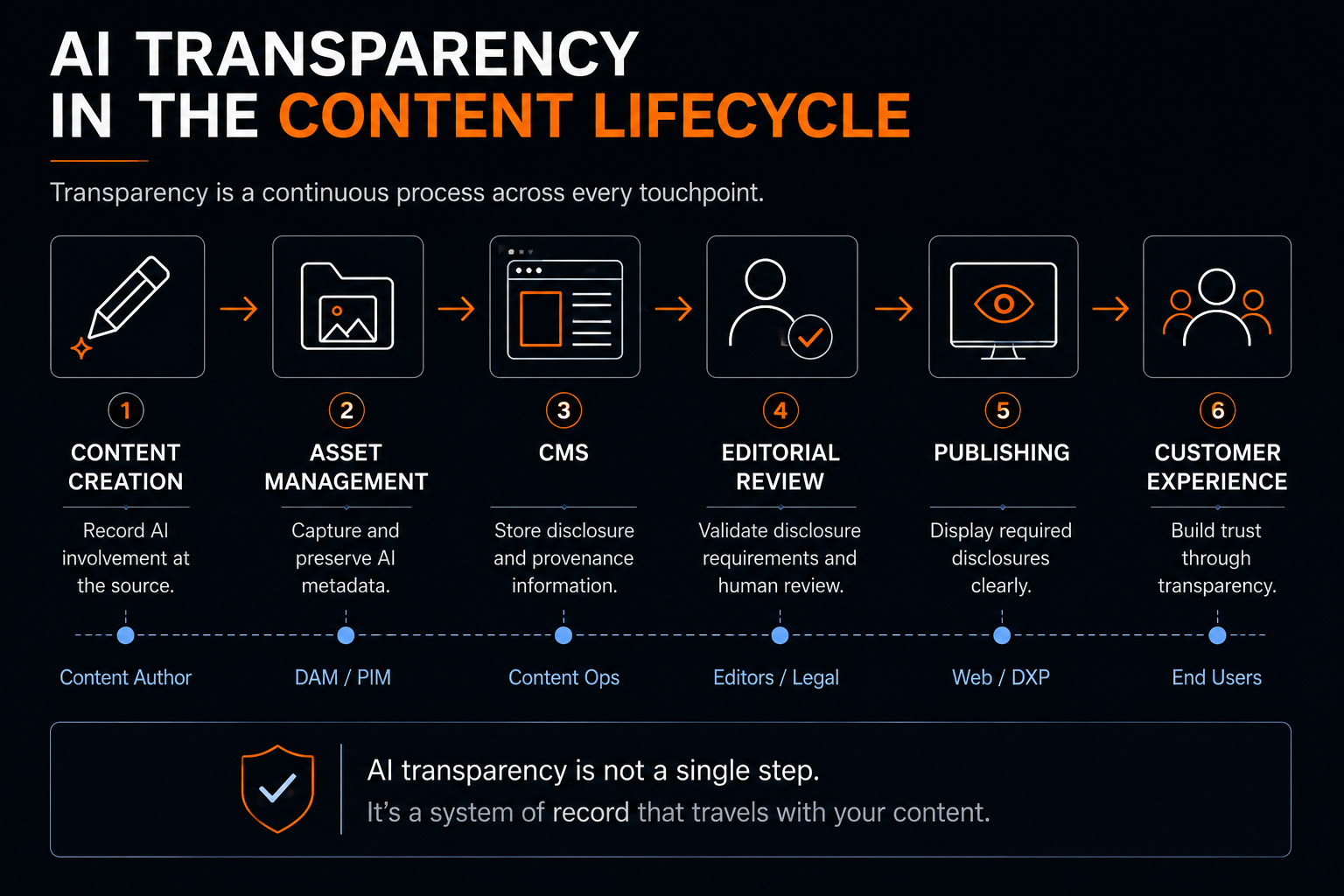
Most CMS platforms will require additional content metadata, typical examples include:
AI generated
AI assisted
disclosure required
disclosure text
human reviewed
provenance available
These fields become the source of truth used by publishing systems, websites, applications, and downstream channels.
Editorial Workflows
Publishing workflows should include validation steps for content that requires transparency measures.
Organizations already use workflow gates for legal review, accessibility compliance, privacy requirements, and brand governance. AI transparency should become another review checkpoint within the same operational process rather than a separate workflow.
Website Publishing
The website, application, or digital experience platform ultimately becomes the point where transparency information is presented to users.
Where disclosure is required, users should be able to understand:
that AI was involved
what type of AI involvement occurred
whether human review took place
The implementation will vary between organizations, but transparency should be visible and understandable within the user experience itself.
Content Provenance
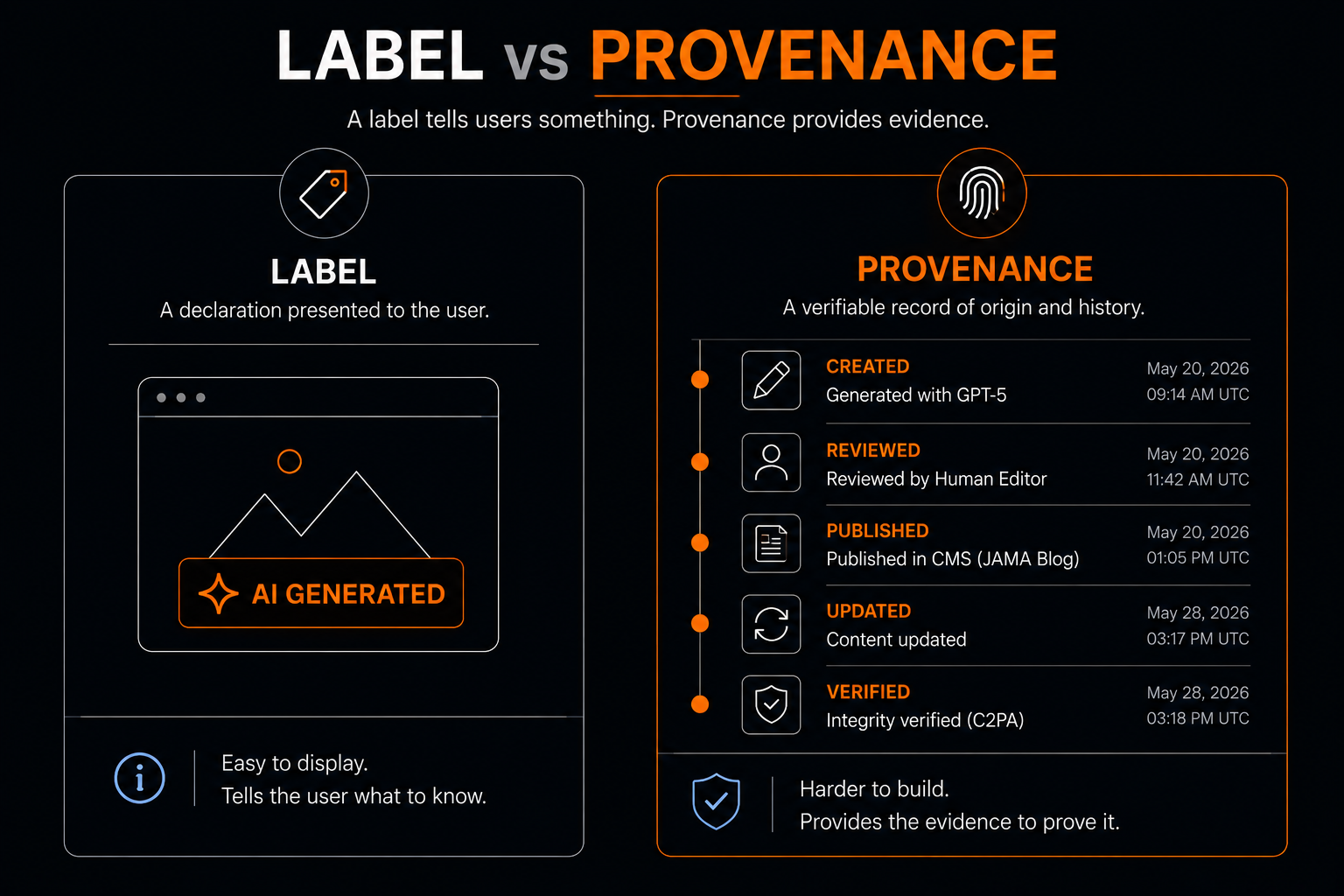
A disclosure label tells users something about a piece of content. The harder challenge is proving that information is accurate.
As content moves through creative tools, DAM platforms, CMS platforms, personalization engines, publishing systems, and external channels, information about its origin can be lost. This has led to increased interest in content provenance, the ability to trace how content was created, modified, reviewed, and published throughout its lifecycle.
Industry initiatives such as C2PA Content Credentials are emerging as practical approaches for preserving provenance information across systems.[3] While the EU AI Act does not mandate a specific technical standard, provenance technologies are becoming an increasingly important part of the broader transparency conversation.
What Teams Should Review Today
Organizations do not need to redesign their entire content operation overnight.
A practical starting point is to assess where AI-generated or AI-manipulated content reaches customers and whether that information can be consistently tracked.
Review:
websites and digital properties
content creation workflows
AI-assisted authoring tools
AI image and video generation tools
digital asset management systems
CMS content models
editorial approval processes
chatbots and virtual assistants
personalization systems
The organizations that will adapt most effectively are not necessarily those using the least AI. They are the organizations that understand where AI is used, preserve that information throughout the content lifecycle, and can communicate it clearly when transparency obligations apply.
References
[1] EU AI Act Article 50 – Transparency Obligations for Providers and Deployers of Certain AI Systems https://artificialintelligenceact.eu/article/50/
[2] European Commission – Code of Practice on Transparency of AI-Generated Content https://digital-strategy.ec.europa.eu/en/policies/code-practice-ai-generated-content
[3] Coalition for Content Provenance and Authenticity (C2PA) https://c2pa.org/
[4] European Commission – EU Icons for Labelling AI-Generated Content https://digital-strategy.ec.europa.eu/en/policies/eu-icons-labelling-ai-generated-content
[5] EU AI Act Implementation Timeline https://ai-act-service-desk.ec.europa.eu/en/ai-act/timeline/timeline-implementation-eu-ai-act
Jehad Alkhateeb
AI & Digital Experience Architect with 11+ years of experience building intelligent systems and leading engineering teams. Based in Toronto, Canada.