Architecting AI Transparency for Modern DXPs
A technical implementation guide for CMS, DAM, DXP, and MarTech teams.
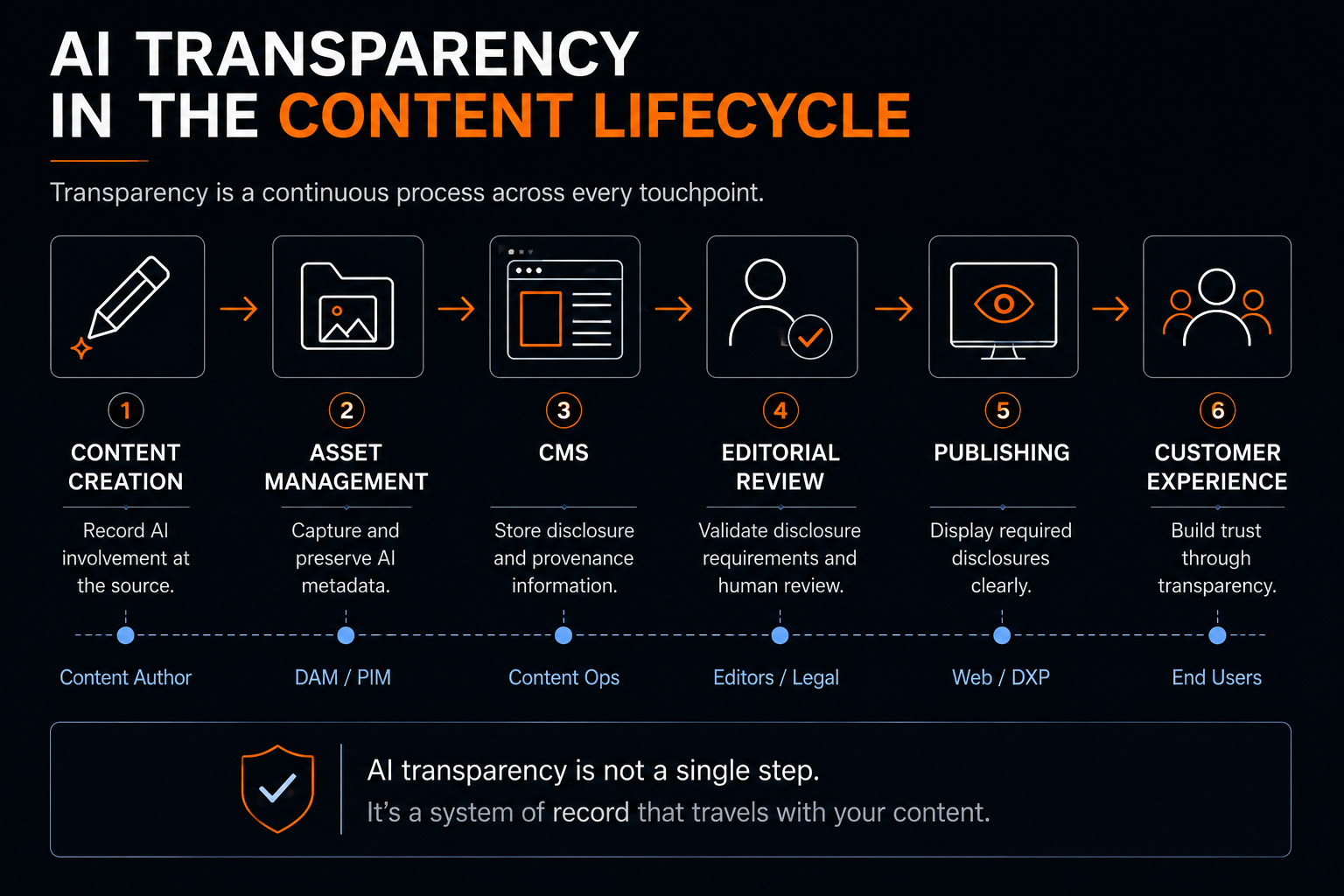
The hardest part of AI transparency is not placing a notice on a page. It is designing the content stack so the publishing layer knows, with evidence, when that notice is required.
By the time AI-generated text, image, audio, or video reaches a website, the technical decision path is already long. A generation tool created or changed the asset. A DAM stored a binary and a rendition. A CMS modeled the entry. A workflow approved it. A delivery API serialized it. A frontend component rendered it. If any handoff drops the AI usage state, the final label becomes a guess.
Article 50 of the EU AI Act makes that operational gap harder to ignore. The transparency rules apply from 2 August 2026 and cover direct interaction with AI systems, synthetic content marking, emotion recognition, biometric categorization, deepfakes, and certain AI-generated or manipulated text published to inform the public on matters of public interest. The European Commission's final Code of Practice on marking and labelling AI-generated content, published on 10 June 2026, adds practical direction for markings, labels, and technical metadata.
For CMS and DXP teams, the implementation target is clear: make AI transparency a content contract. The contract needs fields, validation, workflow state, API exposure, provenance references, and tests. Without those pieces, the UI can display a disclosure but the platform cannot prove why it appeared.
Define the Transparency Contract
Start with a small contract that can survive every system handoff:
aiUsage:
  status: none | assisted | generated | materially_altered | unknown
  generationType: text | image | audio | video | mixed
  sourceSystem: cms | dam | ai_tool | supplier | migration
  modelName: string
  disclosureRequired: boolean
  disclosurePolicy: eu_ai_act_article_50 | internal_policy | channel_policy
  disclosureText: string
  humanReview:
    status: pending | approved | rejected | not_required
    reviewerId: string
    reviewedAt: datetime
  provenance:
    c2paPresent: boolean
    contentCredentialId: string
    manifestUrl: string
    verificationStatus: unverified | verified | stripped | failed
  audit:
    classifiedBy: user | system
    classifiedAt: datetime
    lastChangedBy: string
    lastChangedAt: datetime
Do not treat this as a frontend model. It belongs in the CMS and DAM domain model, then gets projected into delivery APIs. In a composable stack, the fields can be split across asset metadata, entry fields, and derived delivery payloads. The important part is that the platform has one normalized transparency object before content is published.
There are two common modeling mistakes. The first is using only aiGenerated: true. That field cannot represent assisted editing, mixed media, provenance failure, or human review. The second is storing disclosure copy without storing the decision state that produced it. That makes later audit work painful because the team can see what was displayed but not why.
Use content-level metadata for text and page composition. Use asset-level metadata for images, audio, video, and documents. Use a derived page-level transparency summary when an experience combines several components or assets.
{
  "pageTransparency": {
    "disclosureRequired": true,
    "reasons": ["generated_image", "public_interest_text"],
    "highestRiskState": "materially_altered",
    "assetsWithFailedProvenance": 1,
    "humanReviewStatus": "approved"
  }
}
That summary should be computed before delivery, not inferred in the browser.
Put Validation in the Publishing Pipeline
Transparency controls should fail closed at lifecycle boundaries. A developer should be able to point to the exact transition that blocks unsafe publication.
At minimum, add validators to these points:
Draft to review: aiUsage.status cannot be unknown.
Review to approved: humanReview.status must be approved when disclosure is required.
Asset approval: media assets must record provenance verification state.
Publish: disclosureRequired = true requires channel-safe disclosureText.
Publish: page-level summary must include all linked assets and embedded entries.
Delivery build: rendered output must include the disclosure component when required.
A simple rule engine is often enough:
function validateTransparency(entry, linkedAssets) {
  const failures = []

  if (entry.aiUsage.status === "unknown") {
    failures.push("AI usage must be classified before review.")
  }

  if (entry.aiUsage.disclosureRequired && !entry.aiUsage.disclosureText) {
    failures.push("Disclosure text is required before publish.")
  }

  if (entry.aiUsage.disclosureRequired && entry.aiUsage.humanReview.status !== "approved") {
    failures.push("Human review must approve disclosure state.")
  }

  for (const asset of linkedAssets) {
    if (asset.aiUsage.status !== "none" && asset.aiUsage.provenance.verificationStatus === "failed") {
      failures.push(`Asset ${asset.id} has failed provenance verification.`)
    }
  }

  return failures
}
The implementation detail will vary by platform. In Contentful, this might live in app actions, validation services, CI checks against the Management API, or webhook-backed workflow enforcement. In Sitecore or AEM, the same idea may sit closer to workflow commands, template validation, or asset approval flows. The control is the point: content cannot progress when the transparency state is incomplete.
Separate Classification, Rendering, and Audit
Classification should answer what happened. Rendering should answer what the user sees. Audit should answer who decided.
Keep those paths separate in code:
AI classifier or editor input
        |
        v
Canonical aiUsage object
        |
        +--> workflow validation
        +--> delivery API projection
        +--> disclosure component
        +--> audit/event log
The delivery payload should expose enough data for rendering without exposing internal review noise:
{
  "title": "Architecting AI Transparency for Modern DXPs",
  "content": "...",
  "transparency": {
    "disclosureRequired": true,
    "label": "AI-assisted content",
    "description": "This article includes AI-assisted drafting and human editorial review.",
    "provenanceAvailable": true,
    "reviewed": true
  }
}
The audit payload should be richer and should never depend on the frontend:
{
  "entryId": "page-123",
  "eventType": "ai_usage_classified",
  "previousStatus": "unknown",
  "newStatus": "assisted",
  "disclosureRequired": true,
  "actorId": "editor-42",
  "timestamp": "2026-06-22T19:30:00Z",
  "policyVersion": "eu-ai-act-transparency-v1"
}
Version the policy. When Article 50 guidance, internal policy, or channel rules change, teams need to know which rule set produced an old decision. Without policy versioning, every audit becomes archaeology.
Treat Disclosure and Provenance as Separate Controls
A disclosure is a statement. Provenance is evidence.
That distinction matters because C2PA and Content Credentials are sometimes treated as if they solve the whole transparency problem. They do not. They are useful infrastructure for media provenance, but they do not replace CMS governance.
C2PA defines a technical specification for attaching provenance information to digital content through manifests, assertions, signatures, and related metadata. Content Credentials gives users a recognizable way to inspect provenance information when supported by the tool or channel. These mechanisms can help a platform answer where an asset came from, what changed, and whether attached metadata can be verified.
They do not guarantee that every CMS, optimizer, CDN, social platform, or processing pipeline will preserve that metadata. Renditions can strip it. Unsupported channels can ignore it. Composite pages can combine assets with different provenance states. Some Article 50 obligations still require human-readable disclosure at the point of exposure.
The technical pattern is to verify provenance at ingest, store the result as metadata, and re-check after every binary processing step:
Upload original
  -> inspect C2PA manifest
  -> store verification status and manifest reference
  -> generate renditions
  -> test whether metadata survived
  -> store rendition-level preservation result
  -> block or flag publish when policy requires provenance
Do not store only "C2PA present". Store the result of the check:
provenance:
  original:
    c2paPresent: true
    verificationStatus: verified
    manifestHash: sha256:...
  webRendition:
    c2paPresent: false
    verificationStatus: stripped
    generatedBy: image-optimizer-v3
  policyOutcome:
    publishAllowed: true
    disclosureRequired: true
    reason: human_label_required_when_metadata_stripped
This is the part many teams miss. Provenance is not a single field on an asset. It is a set of checks across the asset lifecycle. If the image optimizer strips metadata, the CMS should still know the original had verified provenance and the published rendition does not.
Implement in Thin Technical Slices
The first slice is schema. Add the canonical aiUsage object to the highest-risk content types and media assets. Avoid free-text fields for state. Use enums for status, generation type, review status, policy, and verification outcome. Free text belongs in disclosureText, reviewer notes, and supplier notes.
The second slice is workflow. Add blocking validation to draft-to-review and review-to-publish transitions. Make the validation callable outside the CMS UI so CI jobs, migrations, and bulk imports use the same rule set.
The third slice is API projection. Add a transparency object to preview and delivery responses. Frontends should not inspect raw CMS workflow fields. They should receive a render-ready disclosure model with label, description, display mode, provenance indicator, and review indicator.
The fourth slice is frontend rendering. Build one disclosure component per channel and test it with fixture payloads. At minimum, test no disclosure, inline disclosure, asset-level disclosure, page-level disclosure, and mixed content. Add an integration test that fails if transparency.disclosureRequired = true and no disclosure appears in the rendered DOM.
The fifth slice is provenance. Inspect C2PA or Content Credentials at ingest, store verification results, test renditions, and record whether downstream processing preserved or stripped metadata. Treat failed or stripped provenance as a workflow input, not as a silent warning in an asset tool.
The sixth slice is observability. Emit events when AI usage is classified, disclosure state changes, provenance verification fails, publish validation blocks content, or a page renders a disclosure. Put those events somewhere searchable. Compliance teams will ask for reports, but platform teams need the logs first.
The implementation is not finished when the label appears. It is finished when a developer can trace the label back through the entry, linked assets, workflow decision, provenance check, policy version, and render test without opening a spreadsheet.
Jehad Alkhateeb
AI & Digital Experience Architect with 11+ years of experience building intelligent systems and leading engineering teams. Based in Toronto, Canada.
More Articles
How the EU AI Act Is Changing Digital Content Operations
Understanding what falls within scope, what needs to change, and how content teams can prepare for AI transparency requirements.
Code Is The Artifact. Specs Are The Asset.
How AI-augmented development is shifting what developers actually do, and why the next level isn't about writing code anymore.